 ]]>
]]>
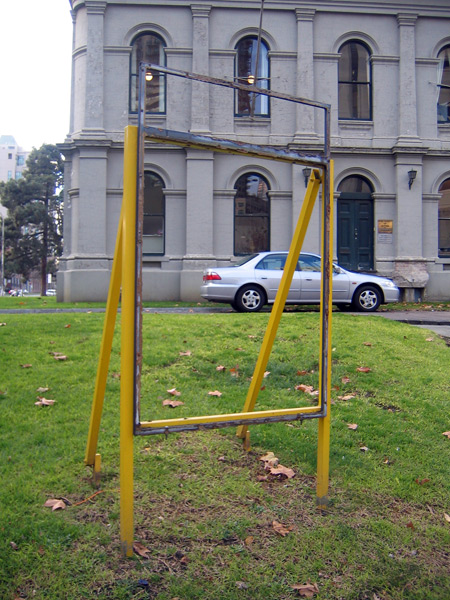
... I have a interest in what I call dead spaces ... I have been wondering within these areas for along time, I seek them out, I interact with them ... I see pathways that don’t exsist ... these path ways and the interaction of the non are how I seek to understand ... what constitutes a dead space is not its pure emptiness, though I seek the empty within them ... they have mulitple stories, and often have lived in past lives or are yet to live, but all are in the present ... they are places where people traverse ... they are free and open, living and breathing a subdued and rasping breath ... each breath is significant, but many refuse the stale air that is expelled ... areas that are dead, may only be so at certain times ... other areas are subjected to a life of ... whilst others opt for ... the empty in their design ... within the dead though is the living, a free state of ... legend ... interpretation ... imagination ... they are places where the other can happen if there is a will to do so ... they hide the lurking truths that are repelled through the mainstream ... the erk of society and life that we try to ignore ... they are all encompasing and disconnected ... ripped from the limbs of the constructed, both physical and mythical ...
During the past three years at RMIT I have been developing an enquiry into the nature, environment and activity of place and space. This enquiry is being made through a design practice that is peformative and situated, in that it engages with the place that the design will manifest within, or the environment that will fuel the outcome.
Within place we find an order, a stability of information that expresses periods of time that have unfolded, of movements and gatherings, of objects and trajectories. I see this as an ordered ether that is in effect a multitude of multidimensional fields made up of memory, tone, presence, environment, sounds, trajectories, light etc in essence varied digital and analogue data. This is what I refer to as a dead space. A dead space is the acknowledgement of life past and life to come, it holds reference to the properties of time, movement, vector and vortex and holds within it possibility for disorder and instability.
Physical materialisation of these data fields is possible through the placing of oneself within a place, and approaching this place with a open mind of enquiry. This period of time, a transitory time, is turning of place into, as Cherteau outlines in The practice of everyday life, a practised place, in that it takes on the properties of time, movement, vector and vortex. Through this engagement with these data fields, dead spaces are explored and become a practised place. In other words a practised place is a period of time within the other-ness of a place, its ether of previous manifestations and connections.
Wondering with empty stomachs, myself and Neal talk slowly as we traverse a foreign city. As we walk we arrive at a roundabout housing an ancient and magnificent fig tree. It stands within the artificial mass of the city, propping itself up by its many tentacles like a mirror opposite of a woodland clearing—a referential space, an incision into the other wise dense surrounds.
The works created during this period are textural and narrative materialisation’s of selected data fields, they are personal poetic interpretations of encounter and intrigue. These works are very much situated within the practice of sampling, of capture and collection, of curation and composition. Through this process we take from the place, we draw from its offering for personal rhetoric and aethestic.
My interest in materialisation extends to, what I call the dissipation of artefact. A things decay and transition into the dead ether of place. Through dissipation we give back to the place, we add to its evolving structures of past and present, its in this period that the artefact is relinquished from the hands of the instigator, of the creator, the designer the performer, composer,. It is here that we find the balancing contradiction of personal aesthetic and collective or social space. The ephemeral artefact then is never finished, it can be argued that it may have never started, that the creative process and its outputs are situated with in transitional space, a continual journey of departure.
I would like to draw on the writings of Cage to underpin my reflections. A sentence of two from the article Forerunners of modern music first published in 1949.
Music means nothing as a thing.
A finished work is exactly that, requires resurrection.
The engagement with the dead space is also an engagement with the state of flow. The state of flow is a conscious yet subconscious processes, using our built knowledge to underlie a subconscious drift. Through this we develop the possibility of ambience and encounter, we acknowledge and converse with the sounds of others and others things.
John Cage in his imaginary conversation with Satie from 1958, has this to say in regards to sound composition.
Why is it necassary to give the sounds of knivess and forks consideration? Satie says so. He is right. Otherwise the music will have to have walls to defend itself, walls, which will not only constantly be in the need for repair, but which, even to get a drink of water one will have to pass beyond, inviting disaster.
Moving forward in a state of self loss, they attune to unseen pathways and the ambient unintended of the city, the two men ‘let themselves be drawn by the attractions of the terrain and the encounters they find there’ (Theory of the Dérive, Published in Internationale Situationniste #2, 1958). Its from these attractions to the terrain that routes open for the men to follow.
Cage, continues on from talking about the sound of the kitchen to conclude by saying, that It is evidently a question of bringing one’s intended actions into relation with the ambient unintended ones. The common denominator is zero, where the heart beats (no one intends to circulate his blood).
By working with and within a space, narratives, materials and objects can be brought together in harmonious collaboration.
The two people that we see drifting through the city create an ephemeral stream of image reflection behind them. As they notice new avenues and signs, these images are feed back into the consciousness through a generative loop of reflection and interpretation, creating a reading of the situation in relation to the themes that have developed with each step. This image trail forms the fabric of the walk, an artefact that is both personal and collective, alternate threads belong to the singular whilst the interwoven structure gives itself to the plural.
This fabric is a process of continual weaving, as one pattern forms or a section of the fabric is deemed to be complete, it is re-woven. This process of re-weaving is not done from scratch, instead its a generative process of working in, through, over and around the threads that are already in place. That is not to say that threads will not dissolve and be lost, move or even meld with others.
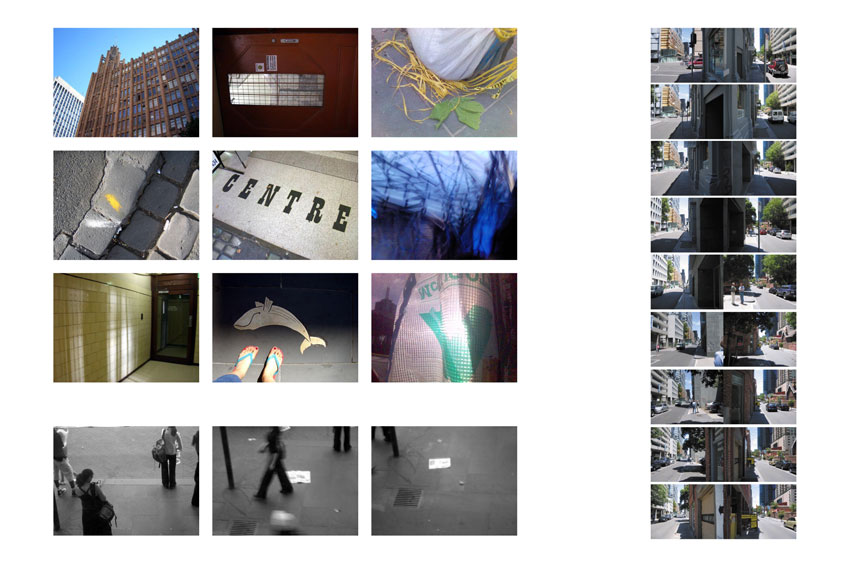
As Neal and I walked around Brisbane in as I term it, a state of self loss, we collected and sampled from the environment through digital photography. As we collected images–captured memory–we curated the narrative that evolved, a narrative held within our conversations and movements.
During this period stills are taken away, digital representations that are stored on devices that offer no visual face. Can we argue that within this digital space, these stills are nothing, reduced to bytes, to common—technic societal—data. Its not that they are nothing, but the bytes that make up the whole do not represent the whole until they are re-formed and interacted with by outside entities. Through our interaction with the city, we perform a similar process, through the reference and drawing of past experience, we weave our own fabric into the image that lies in front.
Underlying this walk was the knowledge that we would do an installation the following day at the Straight Our of Brisbane Festival club house. The space allocated was the back stairway of the festival club. With this in mind we where able to place design parameters around our encounter, a productive statement of intent, which allowed us to follow rather than to seek the poetic of the encounter.
This sounds contradictory, that intent allowed for drift and flow, but it is this position that the Situationists laid as a central process in the Theory of the Derive. They wrote: ... the dérive includes both this letting-go and its necessary contradiction: the domination of psychogeographical variations by the knowledge and calculation of their possibilities.
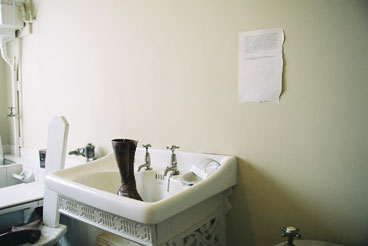
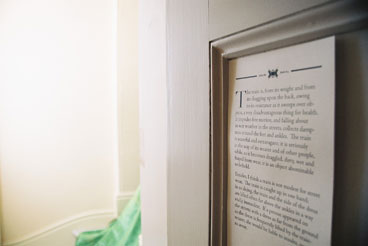
It was through the development and hanging of posters produced from seven images taken during the walk, that we encountered a different place and the space that it would turn into. Through the turning into space the stairwell revealed its intent, it revealed the relationships and activities that would embrace the tone and cosmetics of the narrow room. Hanging next to the posters where pencils and pencil sharpeners, tools to instigate conversations, conversations to be played out on the curated conversation from the previous night. Within Neal and myself we discussed with innocence the nature of conversation that our work would produce, we theorised and imagined the critical engagement of response. What we had been blinkered to was the inherent nature of a place, that a places nature will even through various manifestations will always have a conducting role of behavior. This role is built through the tone that is captured within the walls of a place and the perceptions of such places held within our own cognition.
In this case, our posters captured the stairwells descend into dank lane ways and slut of the toilet, the conversations that evolved where the language of these places, crass and egotistical. At this time we both challenged with the realisation of the other, of the unintended and its effect on the intended, or rather on our intent.
Through processes like the walk that Neal and I took, design opens avenues to reconfigure place, to entice materialisation and happenings. The coming together of people, things and places creates a social space, a place of habitation. When design becomes the instigator of happenings, and it does so with out defending its self from the situation and consequences of the habitation, design becomes a social practice. A practice that can engage with individual aesthetics and renderings but yet one that is at play with its surrounds.
So I see that the creation of social space, the milieu, is built around the conversations that happen within a situation, the inadvertent is an openness to the others, of the possibility of happenings, to become lost within the ether that lies around, yet located within the built perceptions of our lives.
]]>Fashion City was a project that involved the creation of a database of images that explored the fashionable nature of Melbourne. These images where collected through various walks within the city. These images where then edited and curated through their placement into labeled folders. Images could be submitted via email or sms. One of the main outputs of Fashion City was through the image sequencer that played on the screens at Federation Square. This system generated a continuous stream of sequenced image montage.
The sequencer worked with three levels of images that had different properties for playback that could be affected via an XML sequence. The middle layer was a layer that always operated via random discussions on which a body of images would be used for playback. The other two layers had dedicated image sets that could be selected via the XML or set to random, depending upon the desires of the composer, the one that wrote the XML.
This ability to sequence the image patterns with different levels of control was an attempt to draw together a cohesive representation of the images that represented our movements and walks through the city and our engagement with the topic that framed the project. So in this project images where collected and curated with a defined set of rules applied to it, the curation of these images took the images away from the place that they where taken and placed with in a folksonomy.
In contrast the video database that I have been creating during my masters does not place such defined structures around the curation and collection of the clips. The video database is used in real time video performance and is made up of self-filmed performance, car drives, social movement and various built locations that I have encountered and explored. This database is ordered via place and date, leaving the database free to be used with out the possible constraints of labels.
With in these two models of collection and creation it becomes interesting to think of the required knowledge of the collections in order to work with them. In fashion city, it was a knowledge of the images that was required but a knowledge of the tagging system used to order the collection. In the video library there is a real need to know the clips as the folder naming system and the file naming system only gives a very limited clue to the video within. In this respect, as it stands, the video collection of mine is a very personal space, but one that is known by other people through my performances.
]]>My practice equates to this: collection / curation / performance
So i was thinking about the collection period and how within this there is an argument that curation and performance are played out through these processses. What I was thinking was that the potential methodology of this is that the practive is one that works with recursive loops. Which are loops that self call themselve to run again, untill such a time that a variable is matched. So when I walk and travel and go on creative excursions of such excursions happen, this is the process its just that often the parameter that is set to break the loop is often unknown.
note to self: So when I walk and collect, I also curate and often create a performance as I go, this performance is I think a narrative based pursuit that informs the process, in turn the collection and the curation in form the narrative, as does the curation inform the collection and so it goes on.
]]>
]]>
 ]]>
]]>
 ]]>
]]>
 ]]>
]]>
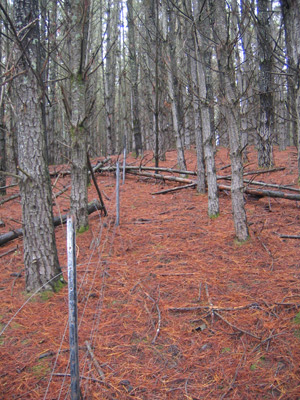
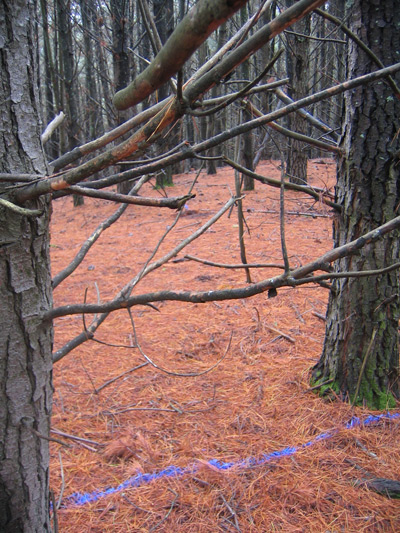
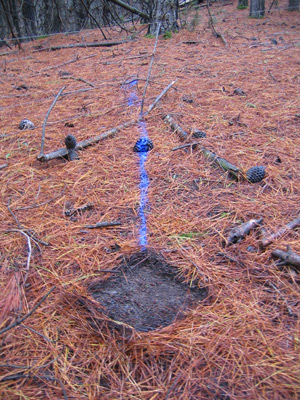
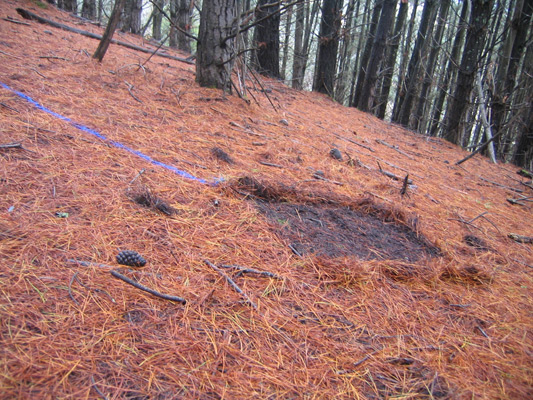
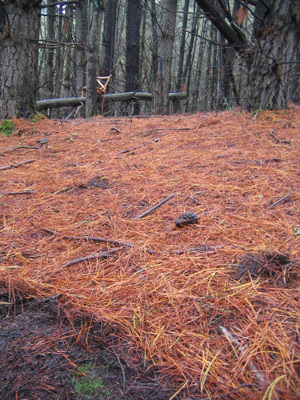
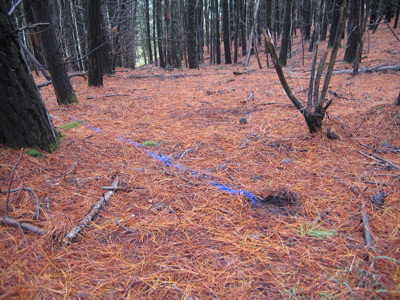
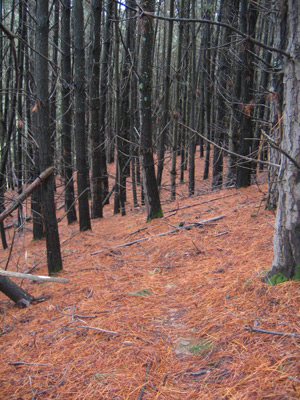
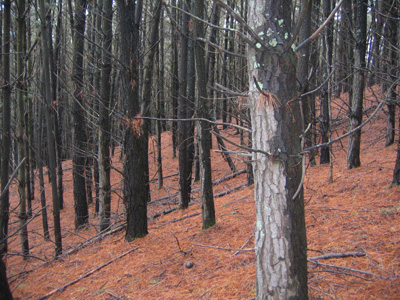
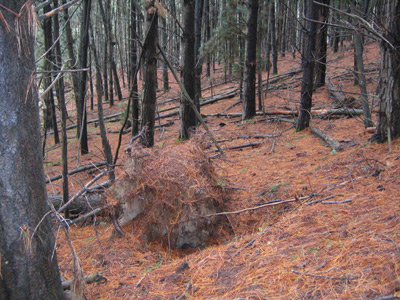
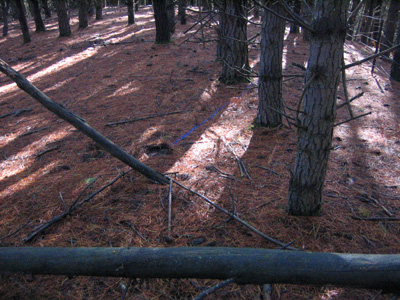
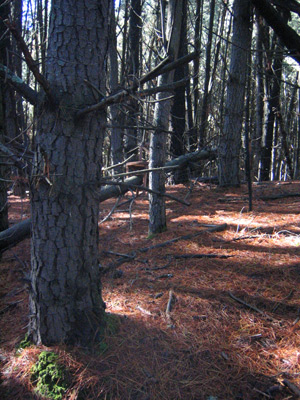
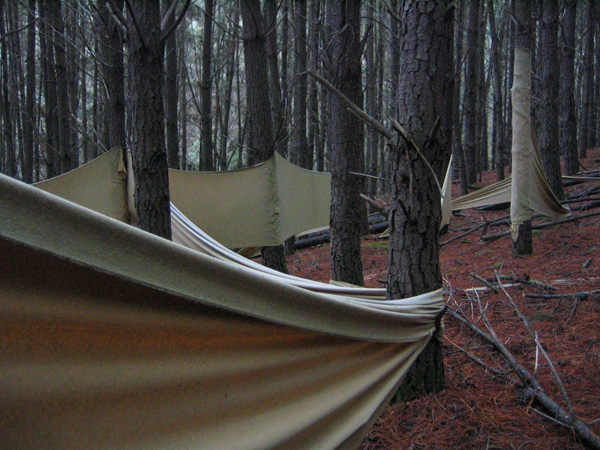
The ground beneath is soft, sponge like, we tread with care, placing each foot with precision. My movements draw me further into a grided terrain. Around I hear the call of birds, but in this space they do not live, for I am in a cancer, a disease imposed by foreign traditions on this delicate land.
So why am I here? What has drawn me into this space? Others where repelled or blocked by themselves and by the forest, others myself included weren't. I desired this space; I lusted after it, not for what it is, but for what it is. In me and in my life a divorce has happened. In the city a relationship is ending, two people once in twined are slowly unravelling the complex structures that held them together. Here in the pine forest that has engulfed me I have disconnected the politics of this space and its cause and effect, to instead embrace the atmospherics and its texturality.
Beneath though, running in a sub routine I am thinking about the girl with whom I have spent so long, and also the politics of this forest and the consequence for indigenous life. I understand that this sub routine is circling into my consciousness, directing and informing a narrative search.
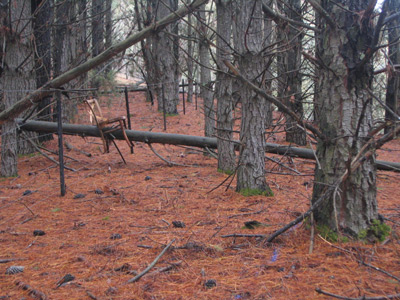
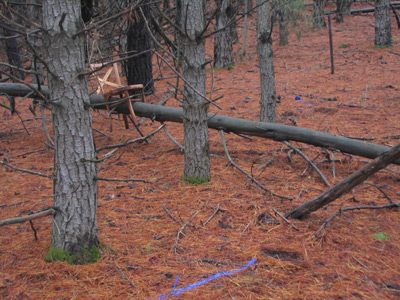
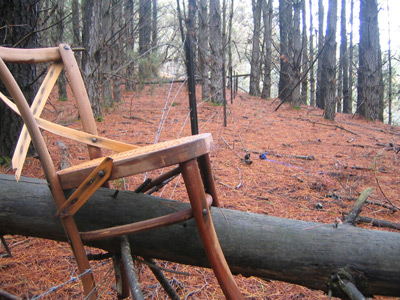
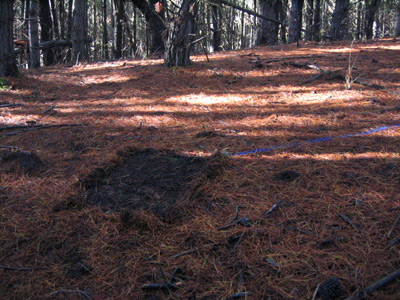
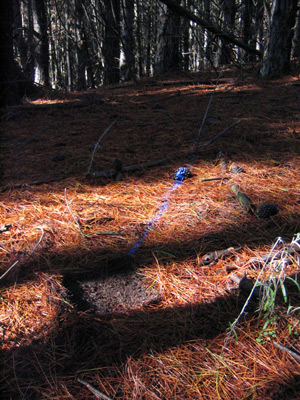
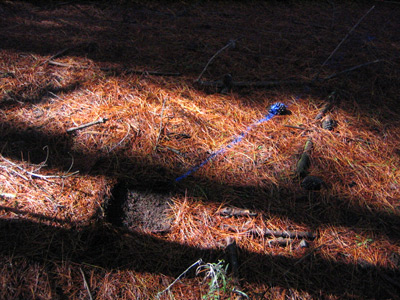
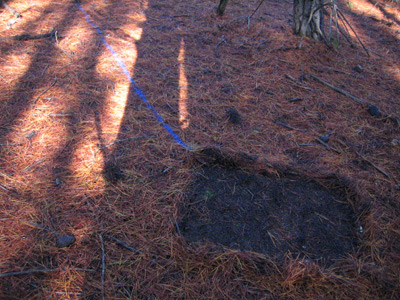
Through the forest our divorcee walks, passing an intervention left by another. The form of this intervention is a continual composition of decay. Through the catalyst that is death, the form shifts, revealing new tensions and textures. In discussion with Laurene, the creator of this structure, it’s revealed that there is an embrace of this changing form, that the subversion of nature has revealed a new poetic taking the design away from the formal constraints that the first iteration had. This embrace of the cycle it seems frees us from the didacticism of purity, perfection, linear and solid.
I am not saying that we should not have a desire, even a purpose; though this scares me and I would like to avoid the Neal effect of this statement. It has to be clear that the aforementioned design, or iteration of a design, served a purpose. But I feel that within the designer’s desire was the affection of the next iteration and the one after, after, after...
Step after careful step we move on, in their minds the yellow fabric and its tangled bondage with the trees is clear. Their focus has been switched.
Beneath the skin words ring, a catalytic move by one has sent these people off into the wood. What defines a wood from a forest, from bush? I used live opposite a wood. So the notion of catalyst surfaces again-its becoming a reoccurring theme, a question-is there a start, an end, what came first, the catalyst or the catalysts catalyst, yeah fuck the egg. With each word I write I create a catalyst, some work backwards, others through, some left, others up, down, forward, behind.v
The response to the words that have been placed within my head is as unimportant as the outcome that is created in the response. This response becomes a catalyst for me and for others, the actions of making a response has many catalysts, so does the movement and conversations that our intrepid explorers have within the situation they find themselves. So in this light is there ever a didactic, a singularity of action or idea? Is subculture not a reaction to an action, I think of Maggie and Jonnie and the mow-hawk movement?
This text stops
Thinks
And starts
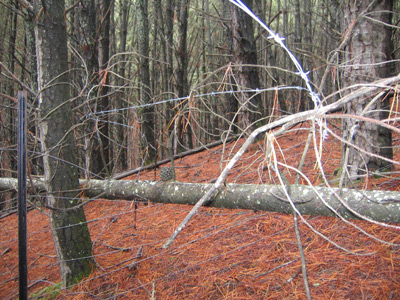
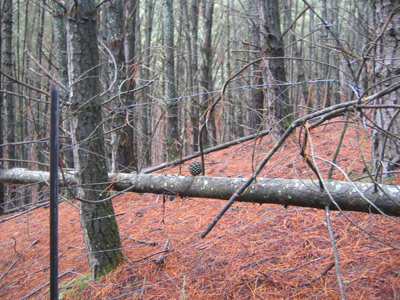
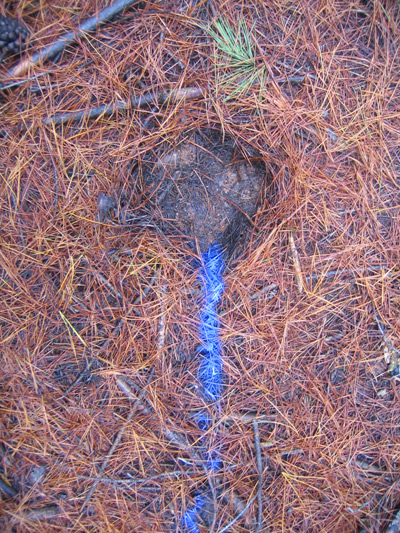
The greater property where a group stays has soft boundaries, fences that can be passed. The signs that orchestrate these actions are not made by people; they are made by the stocky brawn of the local wombats. These creatures, among others, leave pathways and trails that provide access to otherwise inaccessible spaces. Craters alert us to their homes, whilst holes in the fences show us that these creatures view this subdivision of land differently to those responsible for its segregation.
So driven by catalyst I reach a fence, it’s a shock. It’s hard and ribbed with barbs that scream of laceration. Fuck you fence, why are you here, what is your purpose?
To keep you out, you insolent bastard, I will protect my owners land; He does not want you to move any further, I am here to destroy your journey, to ward you off, to subject your poetry.
- But can't we -
- NO, FUCK OFF -
- What, but everywhere else we can -
- FUCK OFF -
- So you are a barrier, a blockade within an undefined space -
- PISS OFF will ya -
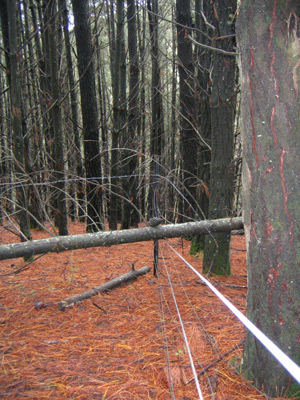
We agree to disagree; actually there is no agreement, just barked order. Following the line of metal up the hill, I smirk when I see the fence below a fallen branch. See, your system is going to break, your boundary will be destroyed, and all that is needed is time, time and patience.
]]>Overall I found the weekend an interesting space to work in a detached mode, allowing for the exploration of materials and ideas that previously where out of reach. What I found interesting though is that what I did, and especially on the Saturday was very much something I would do. The piece seems to fit in with a body of work that I have been doing over the past few years in that its an exploration of a scene/narrative within the context of a system that encourages movement and exploration of the self and of the space. Within this system as with others was the routine of passing in and out, or variant movement. One aspect that was also built into this project was pathways that lead out of the work and back into the surrounds where it was placed. These pathways also lead into the space. Beneath the project laid as with other works a political social questioning.
Day two, was different and in reflection I realise that I shouldn’t have done a thing, as the act of returning to the work of the day before was the outcome that I intended. The reason for this is that going back, looking a fresh with the discussion of the day before in mind, to talk about the work from a different perspective. I think this is what I was trying to convey from the framing system that was created, but at the moment I don't think I like the idea of the work and that I am seriously reviewing the thought around. That though is a quite a good outcome because it has given me the chance to visualise a mode of thinking.
]]>Wondering with empty stomachs, myself and Neal talk slowly as we traverse a foreign city. As we walk we arrive at a roundabout housing an ancient and magnificent fig tree. It stands within the artificial mass of the city, propping itself up by its many tentacles like a mirror opposite1 of a woodland clearing—a referential space, an incision into the other wise dense surrounds. It reminds us of the glorious splendour of the land before my unrelated relatives came and started to build. A process through which great ideologies have been placed upon this terra firma.
The buildings within our field of sight—are there any others?—slowly reveal a politic and a texture within their placement and construction. Across the roundabout between two roads leading to and from this spot, sits, in cocky fluro, a pub that we do not enter. Not that the pub is of dubious character, but the signals it sends tells us that this is a place for a different slice of society. Further round, maybe minus twenty degrees, lies the meshed hole of a building site entrance, within stands another monolith of the corporate sector, a place where many gather beneath the illuminated logo that signifies all that sits with in. The fig, in contrast to these two spaces, stands tall and proud, aware of its and its ancestors place within the laws and pathways of the indigenous people of these lands.
Within these streets we see a variation of time and period 2, from the new and un-constructed, to the past terraces and the lattice work that adorns them, giving face to the old colonies intentions. Offered in nearby windows are the future miniatures that will soon become giants, with their promise of lifestyle and place, these future buildings define the form of the new colonisation, and their argument for a better life. Dark sidings disappear between the buildings, creating dank voids where those that enter do so with risk and intrigue.
Moving forward in a state of self loss 3, they attune to unseen pathways and the ambient unintended 5 of the city, the two men ‘let themselves be drawn by the attractions of the terrain and the encounters they find there’ (Theory of the Dérive, Published in Internationale Situationniste #2, 1958). Its from these attractions to the terrain that routes open for the men to follow. The aforementioned stills serve as memetic references to these routes and the collective consensus that has formed between the two, and within each.
During this period stills are taken away, digital representations that are stored on devices that offer no visual face. Can we argue that within this digital space, these stills are nothing, reduced to bytes, to common—technic societal—data. Its not that they are nothing, but the bytes that make up the whole do not represent the whole until they are re-formed and interacted with by outside entities. Through our interaction with the city, we perform a similar process, through the reference and drawing of past experience, we weave our own fabric into the image that lies in front.
The two people that we see drifting through the city create an ephemeral stream of image reflection behind them. As they notice new avenues and signs, these images are feed back into the consciousness through a generative loop of reflection and interpretation, creating a reading of the situation in relation to the themes that have developed with each step. This image trail forms the fabric of the walk, an artefact that is both personal and collective, alternate threads belong to the singular whilst the interwoven structure gives itself to the plural.
This fabric is a process of continual weaving, as one pattern forms or a section of the fabric is deemed to be complete, it is re-woven. This process of re-weaving is not done from scratch, instead its a generative process of working in, through, over and around the threads that are already in place. That is not to say that threads will not dissolve and be lost, move or even meld with others.
Through these ‘soft’ attractions and the freedom with which they walked, this stroll turned into a dérive. This process has seen them remove the constraints and contracts that the dominant pathways 5 labour them with, turning their actions and movements away from strategy and into tactic (Certeau, Practice of everyday life). This shift sees them detour from the dominant and constructed pathways of the city, to poetic trajectories born through their engagement with the streets.
From here the city is theirs for the purpose that they have proposed, a proposal that has been born through a quite and whispered conversation with the city. On reference this conversation started out with the silent pause 6 that the fig tree created upon our meeting. It, as a reference point, became central to the shaping of the city and the cities shaping of us, and the subsequent conversations that formed there after.
Being open to ‘reference points’ sees the walker able to alter their agenda to reshape their work based on the things that they notice.
----------------------------------------------------------------------------------------------
Notes
1. Mirror opposite [explain]
2. Time is witnessed through the ages of the buildings, and period is seen in their aesthetics and material construction.
3. Self loss [explain] : Stream of consciousness : A conscious state of the unconscious, as ... argues, a state of flow. It is in this state of flow that the individual engages with the tasks at hand in a rigourous and ... manor.
4. Ambient Unintended pause [explain] : First discovered in the essay Eric Satie, John Cage, Silence. Here Satre has proclaimed that we should not ignore the sound of the kitchen fork. As its these everyday things that add the unknown into the equation. Ambient : situation, Unintended : chance/potential
5. Dominant pathways [explain] : Solid states with in the city, they take us to and move us through the cities.
6. Silent pause [explain] : Think about Cage and silence, the space between notes.
]]> ]]>
]]>
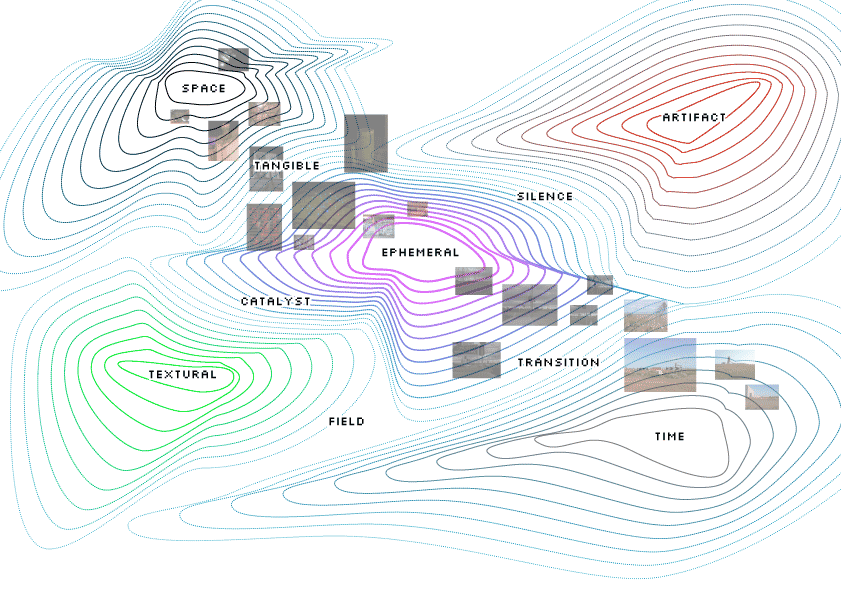
My study of the ephemeral within communication design is centred around the transient state and the individuals engagement with space, time and artefacts. By researching the process of perception in our understanding of events and ideas and applying these principles to the development of systems for interaction and engagement, I am exploring the position and roles of designers, participants, collaborators and viewers and how each person can read, add to and take ownership of the concepts or experiences being explored.
]]> ]]>
]]>
 ]]>
]]>